City Lights, 248 pages, paperback, $16.95
Let me start by saying that I’ve never read any of Charles Bukowski’s work before picking up this book. I remember I was quite young when I stumbled upon an audio clip of one of his poetry readings entitled “It’s Authorized,” and the visualizations provided by that piece that raced through my mind freaked me out.
My next encounter with Bukowski did not occur until about three years ago. I watched a clip from the film Supervan on the website Everything is Terrible and was intrigued by Bukowski’s cameo appearance. I started to read about his life and watch various clips of interviews and poetry readings. At 30 years old, I can now handle the subject matter much better than at 12.
When the opportunity to review More Notes of a Dirty Old Man arose, I jumped at it. I’ve been a fan of the “transgressive fiction” genre of literature for a while now, having read almost every novel released by Chuck Palahniuk, the extremely confusing (yet transfixing) Naked Lunch by William S. Burroughs, and the unapologetic work of Hunter S. Thompson. So to tackle some Bukowski seems like a natural next step.
With the authors mentioned above, their work seems to revolve around some kind of mind-altering substance in relation to their characters. Palahniuk focuses on characters who are addicted to — or, at the very least, fancy — pharmaceuticals. Burrough’s work was inspired by his own addictions to heroin, and Thompson was a madman who experimented heavily with all kinds of substances, and introduced such centralized themes in his stories and novels. But Bukowski’s material embraces the bottle and the down-and-out life of being a man…and a drunk. Rather than disavowing the disease, through his work and in his personal life, Bukowski celebrated it. His raw and unadulterated stories of life as a lowlife have become inspiration to many.
More Notes of a Dirty Old Man – assembled and edited by Bukowski aficionado David Stephen Calonne (who also provides the afterword) – is a collection of short stories, interviews, and columns by Bukowski that were published from the late ’60s into the mid ’80s, many of which originally appeared in The LA Free Press and Open City. The book has no real flow, which at times makes for some difficult reading — especially during some of the interview pieces.
With that being said, it is worth fighting through the slower material to reach some of the short stories. Many feature Bukowski himself as the main character, as he tells tales of being a traveling poet, finding himself in some very particular and unusual situations. Some of the most memorable stories deal with his relationship with women. Bukowski’s view of women has been frowned upon as being sexist and violent, and in some of these stories he lives up to those accusations. But one story in particular reads like a romance novel, as he tells a story about a woman who randomly shows up at his door. Revealing she’s a fan of his work, she wants to see the man who writes like the way he looks (“an undergrown aged gorilla dying of cancer”). They eventually screw in an extremely passionate way, but it’s the way he describes this woman and the details of her body that are so striking. I’ve got to admit, it turned me on.
In the course of this book, Bukowski tells stories of preaching the gospel of alcohol to a group stuck in the drunk tank, the life of being a boxing booking agent who ha fallen on hard times, and a boy who witnesses his demented and twisted dreams come alive. The highlight of the book comes in the form of his nonfictional-inspired fictional story about his encounters with two French men named Jean and Steve. The story, entitled “My Friend, The Gambler,” ends the book on a lighthearted note — no rough sex or drunkards throwing up to send you on your merry little way.
More Notes of a Dirty Old Man highlights some of Charles Bukowski’s forgotten work as a columnist for several publications in the later half of the 20th century. It’s a nice collection that really shows Bukowski’s love of telling stories filled with the grime and the filth of life as a normal working man in a concrete jungle. Some might pass his work by due to the stigma of the subject matter and how he brought it to life by his words (written and spoken), but to do so would be a huge injustice to the world of literature. Some may get it, some may not. But Bukowski’s mark on the world should not to be held in judgment. The man was as real as one can get.
Reviews, Concert Photography and other what-have-yous...
Thursday, February 9, 2012
Monday, February 6, 2012
THE BRAINS – Drunk Not Dead
Take the fury of slap bass-driven psychobilly and mix it with the crooning vocal styles found in the swing revival sound, and you wlll get the The Brains and their new album, Drunk Not Dead.
I must admit that I’m not that familiar with this band, but I do love the lightning-fast psychobilly sound that’s associated with acts like Nekromantix, Tiger Army, and The Reverend Horton Heat. Immediately I was taken in by the opening track, “Four Beast Ride,” with its amazingly fast slap-bass and driving guitars, along with the somewhat out of place crooner vocals of Rene D La Muete. D La Muete’s vocals remind me a lot of Murder By Death’s vocalist Adam Turla (especially the sound of Murder By Death’s song “Brother”), but Muete’s style comes across more along the lines of a lounge singer — Michael Andrew from the swing band Swingerhead comes to mind.
While Muete’s vocals reflect that retro sound, the music does not. Some cuts like “Six Rounds” and “Drunk Not Dead” are more melodic in their sound, reminiscent of The Living End. The harder tracks on the album, such as “Oh Murder” and “High On Speed,” are heavy on guitars and group vocals.
Overall, the 13 tracks featured on Drunk Not Dead are extremely enjoyable. Full of high energy and excellent instrumentation, The Brains are a band I am glad to have discovered.
(Stomp Records, 1223 Blvd. Saint-Laurent, Suite 305, Montreal, QC H2X 2S6 Canada)
I must admit that I’m not that familiar with this band, but I do love the lightning-fast psychobilly sound that’s associated with acts like Nekromantix, Tiger Army, and The Reverend Horton Heat. Immediately I was taken in by the opening track, “Four Beast Ride,” with its amazingly fast slap-bass and driving guitars, along with the somewhat out of place crooner vocals of Rene D La Muete. D La Muete’s vocals remind me a lot of Murder By Death’s vocalist Adam Turla (especially the sound of Murder By Death’s song “Brother”), but Muete’s style comes across more along the lines of a lounge singer — Michael Andrew from the swing band Swingerhead comes to mind.
While Muete’s vocals reflect that retro sound, the music does not. Some cuts like “Six Rounds” and “Drunk Not Dead” are more melodic in their sound, reminiscent of The Living End. The harder tracks on the album, such as “Oh Murder” and “High On Speed,” are heavy on guitars and group vocals.
Overall, the 13 tracks featured on Drunk Not Dead are extremely enjoyable. Full of high energy and excellent instrumentation, The Brains are a band I am glad to have discovered.
(Stomp Records, 1223 Blvd. Saint-Laurent, Suite 305, Montreal, QC H2X 2S6 Canada)
Tuesday, January 31, 2012
THE PLANET SMASHERS – Descent Into The Valley Of The Planet Smashers
It has been six years since Canada’s own The Planet Smashers released their last album, Unstoppable. With their newest effort, Descent into the Valley of The Planet Smashers, not much has changed in their sound. The songs are upbeat and catchy, full of their signature hard-hitting bass line-driven ska-punk, and the lyrics are humorous and lighthearted.
Listening to the 15 tracks featured here, I can’t help but think back and reminisce about the good old ’90s where music like this was being put out on a massive scale. Along with the carefree pop-punk ska sound The Smashers are known for, bands like Buck O’ Nine and early Big D and The Kids Table come to mind when I sit and listen to the material here. The album’s opening cut, “The Hippopotamus,” is extremely catchy, and “UPS of America” presents some social commentary but remains to be humorous and non-preachy.
An unexpected twist comes in at the 12th track in the form of the song “Something Special,” as the band breaks from the punk-ska sound to favor something more traditional in the ska vein.
Descent into the Valley of The Planet Smashers is another enjoyable album from the veteran skankers from the great white north. Fans of the ’90s pop-punk ska sound will dig this.
(Stomp Records, 1223 Blvd. Saint-Laurent, Suite 305, Montreal, QC H2X 2S6 Canada)
Listening to the 15 tracks featured here, I can’t help but think back and reminisce about the good old ’90s where music like this was being put out on a massive scale. Along with the carefree pop-punk ska sound The Smashers are known for, bands like Buck O’ Nine and early Big D and The Kids Table come to mind when I sit and listen to the material here. The album’s opening cut, “The Hippopotamus,” is extremely catchy, and “UPS of America” presents some social commentary but remains to be humorous and non-preachy.
An unexpected twist comes in at the 12th track in the form of the song “Something Special,” as the band breaks from the punk-ska sound to favor something more traditional in the ska vein.
Descent into the Valley of The Planet Smashers is another enjoyable album from the veteran skankers from the great white north. Fans of the ’90s pop-punk ska sound will dig this.
(Stomp Records, 1223 Blvd. Saint-Laurent, Suite 305, Montreal, QC H2X 2S6 Canada)
Friday, December 16, 2011
ZECHS MARQUISE – Getting Paid
In the Rodriguez-Lopez family, musical talent is a strong and vibrant trait. Zechs Marquise’s Malfred and Marcel Rodriquez-Lopez are the younger brothers of The Mars Volta guitarist Omar Rodriguez-Lopez. It appears that the influence of their older brother’s work with Cedric Bixler-Zavala and The Mars Volta have had a large affect on their own musical aspirations and style, especially considering the 12 tracks contained in the group’s latest album Getting Paid.
As someone who’s witnessed a live show featuring Zechs Marquise, I can fully attest to the fact that this album is an honest representation of what you will hear if you see them live in concert. The mix of funky baselines and progressive guitar work that fills the opening track “Getting Paid” really sets the stage for an album that will likely please those who dig intricate instrumentation and electronically manipulated sounds. Getting Paid is mainly an instrumental album, as the first vocals appear nearly 15 minutes into the album, during the third track “Static Lovers.” In an almost haunting performance, guest vocalist Sonny Baker lender her vocals to the track “The Heat, The Drougt, The Thirst, and Insanity,” and RX Bandits vocalist Matt Embree lends his vocals to the song “Everlasting Beacon of Light.”
Getting Paid comes across sounding a lot like The Mars Volta, or at least like the instrumentation and far out progressive sounds as featured on albums like Frances The Mute. While the influence of their older brother’s work comes thought from Malfred and Marcel, they’ve managed to put out an album that impresses and remains fresh through all 12 cuts.
(Rodriguez-Lopez Productions, no address provided)
As someone who’s witnessed a live show featuring Zechs Marquise, I can fully attest to the fact that this album is an honest representation of what you will hear if you see them live in concert. The mix of funky baselines and progressive guitar work that fills the opening track “Getting Paid” really sets the stage for an album that will likely please those who dig intricate instrumentation and electronically manipulated sounds. Getting Paid is mainly an instrumental album, as the first vocals appear nearly 15 minutes into the album, during the third track “Static Lovers.” In an almost haunting performance, guest vocalist Sonny Baker lender her vocals to the track “The Heat, The Drougt, The Thirst, and Insanity,” and RX Bandits vocalist Matt Embree lends his vocals to the song “Everlasting Beacon of Light.”
Getting Paid comes across sounding a lot like The Mars Volta, or at least like the instrumentation and far out progressive sounds as featured on albums like Frances The Mute. While the influence of their older brother’s work comes thought from Malfred and Marcel, they’ve managed to put out an album that impresses and remains fresh through all 12 cuts.
(Rodriguez-Lopez Productions, no address provided)
Thursday, December 15, 2011
DAN P AND THE BRICKS – Watch Where You Walk
Having gone to many ska shows in northern California from the late 1990s through the early 2000s, I remember seeing MU330’s vocalist and guitarist Dan Potthast randomly show up outside venues and play acoustic sets after the conclusion of the concert. Apparently, Potthast decided that Santa Cruz, located about 70 miles south of San Francisco, was calling him as a musician, and he moved there from his hometown of St. Louis, Missouri. With Potthast’s move to California, this left the future of MU330 in the air, and eventually led the band to go on hiatus.
After a few solo albums and heading up the band The Stitch Up, Dan — along with members of defunct Santa Cruz ska act Slow Gherkin — have formed Dan P and The Bricks. Their debut album, Watch Where You Walk, features Potthast’s trademark vocals and songwriting, something that made MU330 stand out from other acts throughout the third-wave ska years of the 1990s.
Although the music with The Bricks sticks to a more toned-down, traditional roots 2-tone ska sound, it’s a definite departure from the sound of MU330’s fast paced punk-ska. Think of the lyrics of MU330 meets sound of The Pietasters. The five-piece horn section has a deep, rich sound — especially with the addition of baritone sax. With the song “One Reason,” Dan is joined by a female vocalist in this throwback tune featuring a doo-wop sound. The band also tackles one of Dan’s solo tunes “Set Sail,” which was featured on his 1999 debut solo album Eyeballs.
Watch Where You Walk is a reminder that while the mainstream hype and attention of ska music is long gone, those who drove that genre to mainstream notoriety are still producing great music.
(Asian Man Records, PO Box 35585 Monte Sereno, CA 95030)
After a few solo albums and heading up the band The Stitch Up, Dan — along with members of defunct Santa Cruz ska act Slow Gherkin — have formed Dan P and The Bricks. Their debut album, Watch Where You Walk, features Potthast’s trademark vocals and songwriting, something that made MU330 stand out from other acts throughout the third-wave ska years of the 1990s.
Although the music with The Bricks sticks to a more toned-down, traditional roots 2-tone ska sound, it’s a definite departure from the sound of MU330’s fast paced punk-ska. Think of the lyrics of MU330 meets sound of The Pietasters. The five-piece horn section has a deep, rich sound — especially with the addition of baritone sax. With the song “One Reason,” Dan is joined by a female vocalist in this throwback tune featuring a doo-wop sound. The band also tackles one of Dan’s solo tunes “Set Sail,” which was featured on his 1999 debut solo album Eyeballs.
Watch Where You Walk is a reminder that while the mainstream hype and attention of ska music is long gone, those who drove that genre to mainstream notoriety are still producing great music.
(Asian Man Records, PO Box 35585 Monte Sereno, CA 95030)
Sunday, November 27, 2011
LOS ANGELES STORIES by Ry Cooder
City Lights, 232 pages, paperback, $15.95
I remember hearing Ry Cooder’s 2005 album Chavez Ravine after my old man burned me a copy of it and said I should check it out, especially after moving to southern California. The concept album tells the story of the Chicano community located just outside of downtown Los Angeles and the ultimate displacement of the residents of Chavez Ravine in order to develop new housing. The housing development plans fell through and the land was given to Walter O’Malley, the owner of the Brooklyn Dodgers, as part of an agreement to bring the Dodgers to LA. That forgotten history was brought to life with Cooder’s concept album — full of Chicano flavor built around Cooder’s guitar work, and Americana roots folk storytelling featuring many larger-than-life characters who were actually involved in the situation at Chavez Ravine.
In many ways, Los Angeles Stories is an extension of the story of Chavez Ravine and the people who inhabited the community. At the very least, it serves as an annex to the Chavez Ravine incident. This is Cooder’s first written work, a collection of short stories he penned over time, originally created for his own enjoyment. After a discussion with Bob Dylan regarding an upcoming tour Ry was heading out on, Cooder was convinced by Dylan to have a small run of these stories printed up to sell at each show. The tour fell through and somehow a copy of these stories — which were thrown together in a hurry — ended up in the hands of City Lights Books in San Francisco.
“I got an email saying, ‘We’d like to put out an edition of this,’ and I said that’s an honor for me – that’s terrific! Really? You sure?” said Cooder in a recent interview conducted on Los Angeles radio station KPCC 89.3 FM. “I’m not a novelist or writer in that sense. It’s just me fooling around, like with music in the same way. Like writing a song.”
The words that occupy the 232 pages of this book bring to life a time long gone. Los Angeles today is a busy and crowded metropolitan mecca, a true concrete jungle where millions of people work, live, and play among the smog-filled air and the bumper-to-bumper traffic. Los Angeles Stories gives us eight short stories set between the 1940s and late 1950s. During this time, LA was looked upon as a place for opportunity for those outside of the West Coast — A destination for folks back east. If it was a job working for Douglas Aircraft (a booming business with the progression of aviation technology) or getting into the music business you sought, LA was the place to be.
On the flip-side, Los Angeles also had a seedy side (and still does, if you care to look for it). Shady characters including schemers, lowlifes, junkies, and con-artists live among the dreamers, especially during the time period featured in Los Angeles Stories.
While some of the stories focus on those who end up in LA, Cooder’s focus in this book is mainly about those who have called LA home for most of their lives. The way Cooder describes the neighborhoods in LA — the homes and the working class — really paints a picture that doesn’t just give you an idea of what it was like; rather, he brings these images to life, especially if you live in or visit LA today. And if anyone can give accurate descriptions of what it was like in those days in Los Angeles, Cooder can since he grew up in these neighborhoods. I found myself saying “Been there!” many times while reading this book, as places like Pershing Square and Philippe’s still stand to this day.
I believe it was Stephen King who once said something like, “I don’t write about extraordinary people, I write about ordinary people in extraordinary situations.” That’s the formula Ry Cooder has used in this book. Most of the stories feature ordinary people — including quite a few musicians — who find themselves in very peculiar situations.
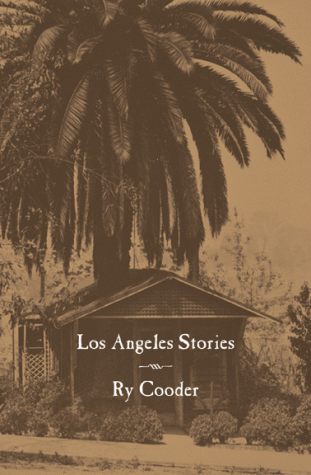
One line we keep hearing throughout this book is police officers telling characters, “Don’t leave town,” as one character after another gets caught up in some incriminating situations. The stories are full of suspense and read a lot like detective novels and pulp magazines (fitting for the era these stories take place). Another amusing thing about the stories is Cooder’s ability to occasionally cross characters from one story into another, giving the reader a feeling that while LA is a big place, it can also be a place where people get around. The cover also sets the stage for the stories found in this book. It features a classic California bungalow with a giant palm tree growing right through the roof, colored in an old film grain color, preparing the reader for a ride back in time.
Los Angeles Stories really captures the feel of LA in the ’40s and ’50s, or at least what I assume it was like. The stories, with a cast of larger than life characters and interesting plot twists, left me turning each page with wonder and interest in what was going to happen next. In the span of 232 pages, I feel like I’ve been to a museum or maybe jumped back in time to a place where I had no ability to be or exist in.
Ry Cooder has earned a reputation of being a wonderful musician with the ability to tell stories with his music. Now, Cooder has taken his storytelling to written form and will likely impress the reading community with his brand of true life-inspired tales of a time long gone. I hope this first time effort by Mr. Cooder won’t be his last. A truly excellent read.
I remember hearing Ry Cooder’s 2005 album Chavez Ravine after my old man burned me a copy of it and said I should check it out, especially after moving to southern California. The concept album tells the story of the Chicano community located just outside of downtown Los Angeles and the ultimate displacement of the residents of Chavez Ravine in order to develop new housing. The housing development plans fell through and the land was given to Walter O’Malley, the owner of the Brooklyn Dodgers, as part of an agreement to bring the Dodgers to LA. That forgotten history was brought to life with Cooder’s concept album — full of Chicano flavor built around Cooder’s guitar work, and Americana roots folk storytelling featuring many larger-than-life characters who were actually involved in the situation at Chavez Ravine.
In many ways, Los Angeles Stories is an extension of the story of Chavez Ravine and the people who inhabited the community. At the very least, it serves as an annex to the Chavez Ravine incident. This is Cooder’s first written work, a collection of short stories he penned over time, originally created for his own enjoyment. After a discussion with Bob Dylan regarding an upcoming tour Ry was heading out on, Cooder was convinced by Dylan to have a small run of these stories printed up to sell at each show. The tour fell through and somehow a copy of these stories — which were thrown together in a hurry — ended up in the hands of City Lights Books in San Francisco.
“I got an email saying, ‘We’d like to put out an edition of this,’ and I said that’s an honor for me – that’s terrific! Really? You sure?” said Cooder in a recent interview conducted on Los Angeles radio station KPCC 89.3 FM. “I’m not a novelist or writer in that sense. It’s just me fooling around, like with music in the same way. Like writing a song.”
The words that occupy the 232 pages of this book bring to life a time long gone. Los Angeles today is a busy and crowded metropolitan mecca, a true concrete jungle where millions of people work, live, and play among the smog-filled air and the bumper-to-bumper traffic. Los Angeles Stories gives us eight short stories set between the 1940s and late 1950s. During this time, LA was looked upon as a place for opportunity for those outside of the West Coast — A destination for folks back east. If it was a job working for Douglas Aircraft (a booming business with the progression of aviation technology) or getting into the music business you sought, LA was the place to be.
On the flip-side, Los Angeles also had a seedy side (and still does, if you care to look for it). Shady characters including schemers, lowlifes, junkies, and con-artists live among the dreamers, especially during the time period featured in Los Angeles Stories.
While some of the stories focus on those who end up in LA, Cooder’s focus in this book is mainly about those who have called LA home for most of their lives. The way Cooder describes the neighborhoods in LA — the homes and the working class — really paints a picture that doesn’t just give you an idea of what it was like; rather, he brings these images to life, especially if you live in or visit LA today. And if anyone can give accurate descriptions of what it was like in those days in Los Angeles, Cooder can since he grew up in these neighborhoods. I found myself saying “Been there!” many times while reading this book, as places like Pershing Square and Philippe’s still stand to this day.
I believe it was Stephen King who once said something like, “I don’t write about extraordinary people, I write about ordinary people in extraordinary situations.” That’s the formula Ry Cooder has used in this book. Most of the stories feature ordinary people — including quite a few musicians — who find themselves in very peculiar situations.
One line we keep hearing throughout this book is police officers telling characters, “Don’t leave town,” as one character after another gets caught up in some incriminating situations. The stories are full of suspense and read a lot like detective novels and pulp magazines (fitting for the era these stories take place). Another amusing thing about the stories is Cooder’s ability to occasionally cross characters from one story into another, giving the reader a feeling that while LA is a big place, it can also be a place where people get around. The cover also sets the stage for the stories found in this book. It features a classic California bungalow with a giant palm tree growing right through the roof, colored in an old film grain color, preparing the reader for a ride back in time.
Los Angeles Stories really captures the feel of LA in the ’40s and ’50s, or at least what I assume it was like. The stories, with a cast of larger than life characters and interesting plot twists, left me turning each page with wonder and interest in what was going to happen next. In the span of 232 pages, I feel like I’ve been to a museum or maybe jumped back in time to a place where I had no ability to be or exist in.
Ry Cooder has earned a reputation of being a wonderful musician with the ability to tell stories with his music. Now, Cooder has taken his storytelling to written form and will likely impress the reading community with his brand of true life-inspired tales of a time long gone. I hope this first time effort by Mr. Cooder won’t be his last. A truly excellent read.
HAVE GUN WILL TRAVEL – Mergers & Acquisitions
Cooking up their own brand of alternative folk, Have Gun Will Travel have released their third album Mergers & Acquisitions. This collection of 12 folk-driven songs break off into many directions including traditional folk, blues, and roots rock and roll, featuring the stellar vocals of Matt Burke.
On first listen, I thought this was a new side project of Tom Petty (yes, the Tom Petty), as Burke’s vocals are eerily similar to Petty’s singing voice (both outfits are out of Florida, Petty from Gainesville and Burke from Bradenton), with a hint of Bob Dylan thrown in. A majority of the songs on Mergers & Acquisitions tell stories; songs about life on the road, traveling, and days of old.
With Burke’s memorable vocals and the music provided by the backing band — especially with the use of steel guitar provided by Scott Anderson — the album relies on the traditional folk style, but with toe-tapping tunes like “Song of Seven Sisters,” the album cruises along like an Americana road trip through the heart of this nation. This is an all around enjoyable album full of infectiously catchy songs and moving stories beautifully sung by Burke.
(Suburban Home Records, PO Box 40757, Denver, CO 80204)
On first listen, I thought this was a new side project of Tom Petty (yes, the Tom Petty), as Burke’s vocals are eerily similar to Petty’s singing voice (both outfits are out of Florida, Petty from Gainesville and Burke from Bradenton), with a hint of Bob Dylan thrown in. A majority of the songs on Mergers & Acquisitions tell stories; songs about life on the road, traveling, and days of old.
With Burke’s memorable vocals and the music provided by the backing band — especially with the use of steel guitar provided by Scott Anderson — the album relies on the traditional folk style, but with toe-tapping tunes like “Song of Seven Sisters,” the album cruises along like an Americana road trip through the heart of this nation. This is an all around enjoyable album full of infectiously catchy songs and moving stories beautifully sung by Burke.
(Suburban Home Records, PO Box 40757, Denver, CO 80204)
Subscribe to:
Posts (Atom)